- English
- French
- German
- Portuguese
- Spanish
- Russian
- Japanese
- Korean
- Arabic
- Greek
- German
- Turkish
- Italian
- Danish
- Romanian
- Indonesian
- Czech
- Afrikaans
- Swedish
- Polish
- Basque
- Catalan
- Esperanto
- Hindi
- Lao
- Albanian
- Amharic
- Armenian
- Azerbaijani
- Belarusian
- Bengali
- Bosnian
- Bulgarian
- Cebuano
- Chichewa
- Corsican
- Croatian
- Dutch
- Estonian
- Filipino
- Finnish
- Frisian
- Galician
- Georgian
- Gujarati
- Haitian
- Hausa
- Hawaiian
- Hebrew
- Hmong
- Hungarian
- Icelandic
- Igbo
- Javanese
- Kannada
- Kazakh
- Khmer
- Kurdish
- Kyrgyz
- Latin
- Latvian
- Lithuanian
- Luxembou..
- Macedonian
- Malagasy
- Malay
- Malayalam
- Maltese
- Maori
- Marathi
- Mongolian
- Burmese
- Nepali
- Norwegian
- Pashto
- Persian
- Punjabi
- Serbian
- Sesotho
- Sinhala
- Slovak
- Slovenian
- Somali
- Samoan
- Scots Gaelic
- Shona
- Sindhi
- Sundanese
- Swahili
- Tajik
- Tamil
- Telugu
- Thai
- Ukrainian
- Urdu
- Uzbek
- Vietnamese
- Welsh
- Xhosa
- Yiddish
- Yoruba
- Zulu
How Many Hours Do You Get From Washpipe Assy AY10031?
All Washpipe Assy AY10031 can be used for an unlimited amount of time. The mud pressure, the solids in the drilling fluid, the rotation speed, how well it was put in place, how straight it is, and how often the crew checks the packing all affect how long something lasts. Even if two rigs have the same part number, they might not work at all the same. It's best to keep track of the hours, leaks, stable pressure, and wear that can be seen in real life. Since those signs show that the part is no longer safe to hold, it needs to be changed. What changes the service life? This guide tells you. To be sure you order the right replacement, it also tells you how to tell if something is in good shape.
Understanding the Service Life of Washpipe Assy AY10031
It uses a top drive to move drilling fluid from the still gooseneck to the moving drill string. The pressure inside the washpipe stays the same while the shaft turns it. As it always rubs against something, the washpipe is the part that wears out. We measure its life in hours instead of years because of this.
With the part number AY10031, you can find it. It doesn't say exactly what size, thread, or seal arrangement it has, so you should always check it against the model of your gear.
One more thing I tell buyers: keep these five terms separate:
- Design life: what the engineer planned.
- Expected operating life: what similar conditions usually produce.
- Warranty coverage: protection against defects, not a promise of hours.
- Inspection interval: how often you check the part.
- Replacement timing: when the part actually comes out.
Any claim about service life isn't as reliable as the records you keep in the field.
The Main Factors That Determine Service Life
Heat and pressure both affect how fast something wears out. As the levels rise, the seals, lubricant, and connections all break down more quickly. The surface also wears down faster when it is turned quickly all the time than when it is only used sometimes.
Also, the water that is used for drilling is very important. Garbage, chemicals that break down metal, and dirty mud all wear down the sealing surface and the flow grooves. That's where the solids go when the desander or shaker doesn't work right.
The most direct thing that crews can change is how well the parts were put in. It is safer to put the parts together when they are clean, the torque is right, and the shaft is in the right place. The washer will wobble if it is not lined up straight. This wears down the surface unevenly and shortens the life of the packing. A pressure test before use and seals that work well together can help find many problems early on.
I think you should just write down the number of leaks, vibrations, pressure, temperature, RPM, and maintenance work that you do for the AY10031 Canrig wash pipe assembly. That log backs up what you say.
How to Tell Whether the Assembly Needs Repair or Replacement
If you hear or feel strange noises or vibrations, see more leaks, feel too much heat, see corrosion, hear loud scoring, or keep breaking seals, it means that your washpipe isn't working right.
The only parts that need to be fixed are the ones that can be changed, like the packing. The main body is fine and on the right side of normal. New things are better if they have deep scratches, rust, leaks that come back after being fixed, a service history you don't know about, or parts you can't find.
Cost is also a factor. What went wrong with the inspection? How much will the repairs cost? How long will it take to fix? How important is the rig? Most of the time, a planned replacement costs more than a cheap fix that breaks during a drill run.
Compatibility and Specifications of Washpipe Assy AY10031
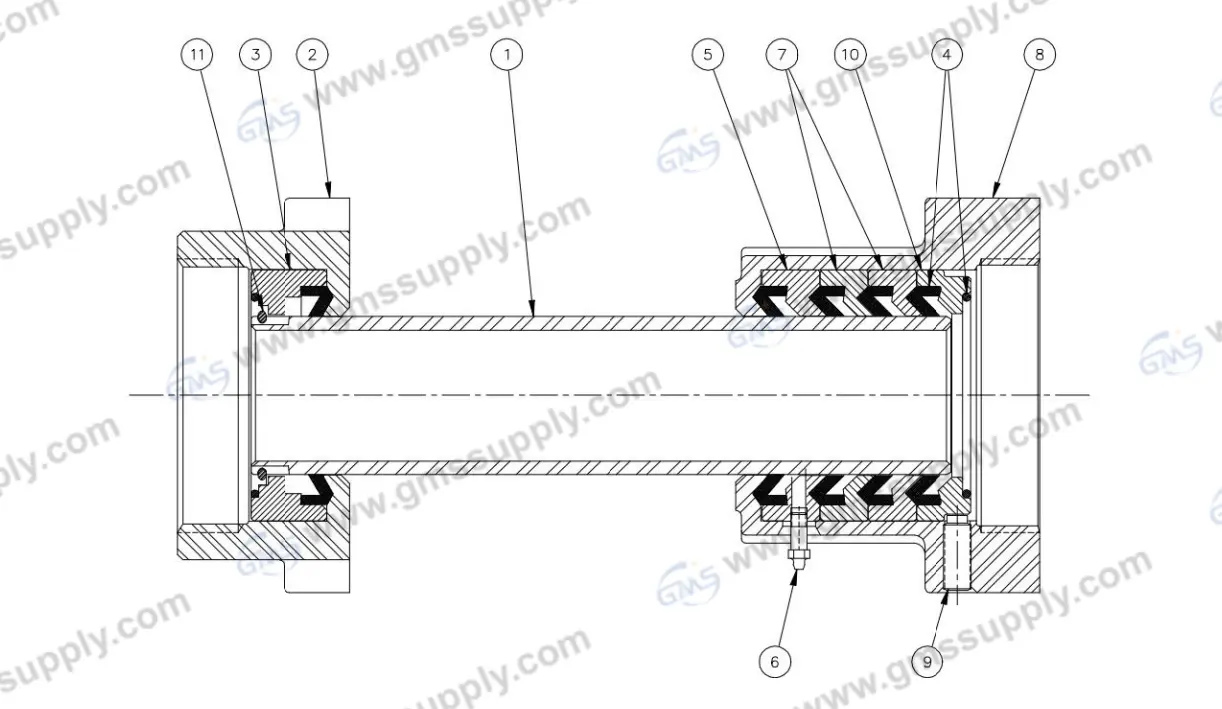
It is important to know the full length, inner and outer diameters, type of thread or connection, mounting dimensions, seal configuration, pressure rating, temperature range, and grade of the material before you place your order. When your quality program tells you to, take pictures, get certificates for materials, write up inspection reports, and keep records of pressure tests. Check that these match not only the part number but also the exact model of the top drive.
About the parts we sell, we keep the following information:
| Feature | Details |
|---|---|
| Product Name | Washpipe Assembly AY10031 |
| Part Number (P/N) | AY10031 |
| Application | Top drive system |
| Top Drive Models | Canrig 8035, 8050, 6027 |
| Origin | China |
| Lead Time | Stock |
| Certificate | ISO 9001 |
This replacement part from GMS is made to work well when you are drilling and the temperature and pressure are high. It moves with the drill pipe, keeps things smooth and sealed, and sends drilling fluid through the top drive.
A Practical Inspection and Maintenance Plan
I see maintenance as having four steps. Make sure you know the part number, size, shape, and condition of the seal's threads and surfaces before you put it in place. Installers who are qualified should do things like align, torque, and grease the parts correctly. They should also write down the starting points and check the pressure.
Watch the mud's temperature, RPM, vibration, leakage, and pressure while the part is being used. If an alert level is set ahead of time, everyone on the crew will know what they need to do. Every once in a while, you should check the connections, flow paths, wear surfaces, tolerances, and seals.
Write down how long it worked, what went wrong, and how the damage was done after you take apart the AY10031 Canrig wash pipe assembly. After that, picture it. You can use the notes to figure out what went wrong and plan to buy better things next time. This plan doesn't depend on a single number to make things last longer.
How to Estimate the Remaining Life of Washpipe Assy AY10031
Hours don't show everything. It might still work after 100 hours of use in rough fluid if it was used for 200 hours in clean mud. It's better to use more conditions when making estimates.
First, write down when it was put in place, how many hours it was run, the pressure, the temperature, the speed of rotation, the properties of the mud, maintenance work, leaks, and emergency repairs. Then add things that can be measured, like how fast the seals leak, how stable the pressure is, how the temperature changes, how the machine shakes, and how the sizes change over time.
Choose the level of replacement before something goes wrong and forces you to do it. Allow certain amounts of leaks, pressure loss, wear, and temperature rise. Always keep a spare that has been checked out on hand for important rigs. It takes a long time to make spares and ship them around the world. Keep that in mind when you decide how many. For example, ISO 14224 standards let you keep these kinds of records.
Buying Guide: How to Order Washpipe Assy AY10031
A thorough look at something can help you save days. Include the type of part, the model of the equipment, what it will be used for, how much of it there is, how it will be used, the measurements, the connections, the materials that are needed, the certificates that are needed, the destination, the date of delivery, and the export packaging that is needed. It's faster to see if two things work together when you use pictures and drawings.
Don't just compare prices when you get quotes; compare how much the whole thing is worth. Take a look at the amount of stock, the lead time, the freight, the payment terms, the warranty, the testing, the paperwork, the technical support, and the speed with which you can get it. What else should they think about? Are the batches always the same? Is it easy to keep track of them? Can they send the goods to more than one place?
Some good questions to ask any supplier are:
- Do you have stock now?
- What experience do you have with my top drive model?
- How do you test the assembly before shipment?
- What warranty and after-sales support do you offer?
You can buy things faster and with less risk if you know the answers to these questions.
Why Work With GMS as Your Washpipe Assy AY10031 Partner
They send more than just boxes. People who buy things from GMS can count the parts, make sure the tools they buy work with the parts, double-check the measurements, and look into early failures. We've been giving the oil and gas business what they need for more than ten years. We're in charge of everything, from the materials to the goods that are delivered. In other words, each batch is of the same quality.
Procurement teams know that we will have a lot of stock, short lead times, quick responses, and service after the sale. We also have choices that can be changed to match various projects.
There are parts for the top drives of the TDS-11SA, the TDS-9SA, and the Canrig. This is also where you can find EG-250 centrifugal pumps and parts, as well as Becker vacuum pumps and mud pumps. That range has a lot of different things for people who run fleets, buy MRO, or work with distributors.
Conclusion
If you want to know how long the Washpipe Assy AY10031 lasts, you need to look at the pressure, temperature, rotation, condition of the mud, alignment, installation, and maintenance. There is no set number of hours that can be used to explain it. The most reliable way is to use inspection results along with records of how the system was used and observable signs like wear and leaks. Broken, deeply scored, corroded, or leaky parts need to be replaced. Parts that are worn out but not too badly can be fixed. To check if it works, you can't just look at the part number. You should also look at the model, size, connections, and shape of the seal. Don't forget to add the time it takes to deliver, fix, and shut down. When sets are no longer safe to use or cost too much to run, they should be thrown away.
FAQ
1. What's the difference between the service lives of Washpipe Assy AY10031?
The results are also different for each rig because of how it is aligned, maintained, pressed, heated, rotated, and how rough the mud is.
2. Send the top drive's model number, size, connections, pressure, temperature, drawings, and photos to make sure they work with the other one. We use the Canrig 8035, 8050, and 6027.
3. When should you fix something?
If the body stays within tolerance, damage to wear parts that can be changed can be fixed. You should get a new one if it cracks, scores deeply, or leaks a lot.
4. Are you sure you have the part?
It says in the message that the Washpipe Assembly AY10031 is in stock. Get in touch with us to find out about export and shipment paperwork, as well as the current amounts.
Request a Quote for Washpipe Assy AY10031
GMS is a Washpipe Assy AY10031 supplier that has a lot of items in stock and is ready to ship them right away. To get the equipment where you want it to go and when you want it there, email sales@gmssupply.com with the model, quantity, operating conditions, photos, and email address. We will check to see if it works and then get back to you with a price quote and lead time.
References
1. API Specification 7K, Drilling and Well Servicing Equipment, 2015
2. API Specification 8C, Drilling and Production Hoisting Equipment, 2012
3. ISO 14224, Petroleum, Petrochemical and Natural Gas Industries: Collection and Exchange of Reliability and Maintenance Data for Equipment, 2016
4. ISO 9001, Quality Management Systems: Requirements, 2015
5. Applied Drilling Engineering, Society of Petroleum Engineers, 1986
6. Standard Handbook of Petroleum and Natural Gas Engineering, Gulf Professional Publishing, 2016
Learn about our latest products and discounts through SMS or email