- English
- French
- German
- Portuguese
- Spanish
- Russian
- Japanese
- Korean
- Arabic
- Greek
- German
- Turkish
- Italian
- Danish
- Romanian
- Indonesian
- Czech
- Afrikaans
- Swedish
- Polish
- Basque
- Catalan
- Esperanto
- Hindi
- Lao
- Albanian
- Amharic
- Armenian
- Azerbaijani
- Belarusian
- Bengali
- Bosnian
- Bulgarian
- Cebuano
- Chichewa
- Corsican
- Croatian
- Dutch
- Estonian
- Filipino
- Finnish
- Frisian
- Galician
- Georgian
- Gujarati
- Haitian
- Hausa
- Hawaiian
- Hebrew
- Hmong
- Hungarian
- Icelandic
- Igbo
- Javanese
- Kannada
- Kazakh
- Khmer
- Kurdish
- Kyrgyz
- Latin
- Latvian
- Lithuanian
- Luxembou..
- Macedonian
- Malagasy
- Malay
- Malayalam
- Maltese
- Maori
- Marathi
- Mongolian
- Burmese
- Nepali
- Norwegian
- Pashto
- Persian
- Punjabi
- Serbian
- Sesotho
- Sinhala
- Slovak
- Slovenian
- Somali
- Samoan
- Scots Gaelic
- Shona
- Sindhi
- Sundanese
- Swahili
- Tajik
- Tamil
- Telugu
- Thai
- Ukrainian
- Urdu
- Uzbek
- Vietnamese
- Welsh
- Xhosa
- Yiddish
- Yoruba
- Zulu
Why Packing for 250 Centrifugal Pump Prevents Leakage?
Packing for 250 Centrifugal Pump is the main thing that keeps expensive fluid from leaking out of industrial pumping systems and affecting how well they work. When this compression sealing material is put in the stuffing box where the rotating shaft meets the fixed pump case, it makes a controlled seal that lets the shaft rotate while keeping fluid loss to a minimum. When properly installed, shaft packing in centrifugal pumps lets a small amount of fluid leak out. This lubricates the shaft interface and gets rid of frictional heat, keeping the pump's integrity in heavy industrial settings, chemical processing plants, and oil and gas drilling sites.

Understanding the Role of Packing in 250 Centrifugal Pumps
One of the most important but often forgotten parts of keeping operations going is the shaft closing system in 250 Type centrifugal pumps. Leakage-related problems cause a lot of unexpected downtime and repair costs when we look at pump breakdowns across oil pumping activities.
Models like P/N 25014-04M-B have a lantern ring design that adds a flush feature that greatly increases the packing's life. This design keeps rough particles from pressing against the shaft sleeve by putting clean fluid between the packing rings. The fluid also takes away the heat from the friction. From working with oil drilling companies, we know that lantern ring systems that are set up correctly can triple the time between packing service intervals compared to normal setups.
A visual check shows several warning signs of packing decline that must be seen before it fails completely. Surface glazing means that too much heat is building up because the glands aren't oiled enough or are adjusted too tightly. Fibre release, in which individual strands come loose from the coiled structure, is a sign of either chemical attack or too much mechanical stress. Shaft sleeve scoring, which can be seen as lines around the outside, is caused by sharp particles getting inside or not doing enough to break in the packing.
Monitoring the temperature gives a precise picture of the state of the packing. If the temperature of the stuffing box goes above 180°F in water-based uses, it means that there isn't enough leaking to cool the box or that the packing is about to fail. Using infrared thermography during operation to find hot spots that show where failures are likely to happen allows for focused action before the whole seal breaks.
Common Problems with Packing and How to Solve Them
If the leaking gets worse over hours instead of days, it's likely because the torque on the gland follower bolt has loosened up from heat cycle. Retightening each bolt in a cross-pattern pattern by no more than a quarter turn at a time returns compression without causing shock loads that break up the packing structure. Ring extrusion happens when packing material pushes past the gland follower and into the pump's innards, such as with MISSION 25014-04M-B. This is shown by sudden leaking spikes and changes in the shaft's shaking.
Service life depends on both the quality of the materials and how they are installed. To stop straight-through leaking routes, each ring has to be cut at a precise 45-degree angle. Joint shifting every 90 degrees (for four-ring setups) or 120 degrees (for three-ring setups) gets rid of the need to match the cut surfaces. We have proof that good joint staggering alone increased the life of packing from three weeks to four months when used with rough drilling mud.
The repair process needs to be carried out in a methodical way. Once the pump is turned off and the pressure is released, take out the gland follower and use a corkscrew-style removal tool to get rid of the used packing. Screwdrivers can damage the stuffing box hole if you use them. Clean up any leftover packing pieces and check the surface finish of the shaft sleeve. Roughness greater than 32 RMS microinches speeds up the wear of new packing. Check the depth of the filling box to make sure there is enough room for the number of rings listed, plus a lantern ring if needed.
Putting on new rings requires placing each one carefully and pressing down on it with your hand before adding the next one. When you try to enter the whole packing set at the same time, it causes uneven compression and leaking right away. At first, the gland follower should be threaded finger-tight. This lets the pump run at a slower speed while controlled leaking forms the lubricant film. The best tension is reached by gradually tightening over 15 to 20 minutes without using heat shock.
Adjusting the glands is a skill that you can learn that matches how well they seal with how long they last. Too much tightening causes too much friction, which raises the temperature inside the stuffing box above what the material can handle. This leads to carbonisation happening too soon. Under-compression lets pressure pulses work the packing loose, which speeds up the wear process. When the system is in the goal state, it drips slowly, wetting the shaft sleeve without making streams or drops.
Choosing the Right Packing for Your 250 Centrifugal Pump
Material architecture determines performance boundaries across operating envelopes. Understanding these distinctions enables procurement managers to match packing specifications to actual service conditions rather than relying on generic recommendations.
Braided construction methods influence fundamental packing behavior. Interlocked braiding—where yarns mechanically interweave—provides dimensional stability that prevents unraveling when rings are cut to length. Braid-over-braid construction offers higher density and improved conformability to shaft irregularities but requires careful handling during installation. The choice between these architectures affects both field machinability and sealing consistency.
Graphite-acrylic packings excel in high-temperature applications up to 650°F, making them ideal for pumps handling heated process fluids or operating in high-ambient environments like oil drilling rig engine rooms. The graphite component provides self-lubrication and thermal conductivity exceeding 100 W/m·K, while acrylic binders maintain structural integrity. This combination suits the MISSION Magnum 250 pump, such as with MISSION 25014-04M-B, when processing drilling muds with elevated temperatures from deep-well operations.
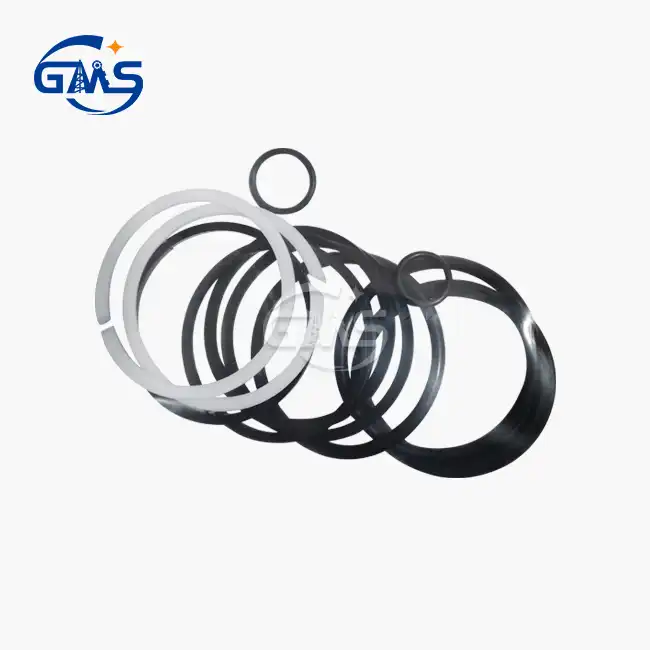
Teflon-based packings offer the broadest chemical compatibility, remaining inert across pH ranges from 0 to 14 except for molten alkali metals and elemental fluorine. The low friction coefficient—typically below 0.1—reduces shaft wear and power consumption, though PTFE's limited temperature ceiling of 500°F restricts application scope. White Teflon packings (P/N 250147-04M-D) provide visual leak detection advantages, as fluid staining becomes immediately apparent during inspection rounds.
Comparing lifecycle economics reveals that initial material cost represents a small fraction of total ownership expenses. A premium graphite packing costing 40% more than economy alternatives typically delivers triple the service life while reducing emergency intervention frequency. When we factor in labor costs for replacement, production losses during changeovers, and potential equipment damage from seal failure, the value proposition shifts dramatically toward quality materials.
Procurement Considerations for Packing of 250 Centrifugal Pumps
Technical compatibility verification prevents costly mismatches. The MISSION Magnum, MCM 250, HALCO, Harrisburg, and TSC pump families share similar stuffing box dimensions but differ in shaft sleeve materials and surface finishes. Experienced suppliers provide application engineering support, matching packing specifications to actual operating conditions rather than merely cross-referencing part numbers. Our decade of experience serving oil drilling contractors has built comprehensive application databases that streamline specification processes.
Certification and compliance documentation protect buyers from quality variations. ISO 9001 certification demonstrates systematic quality management, though drilling industry buyers should verify that the certification scope encompasses the specific product categories being purchased. Material test reports confirming density, compressibility, and recovery characteristics per ASTM F36 standards provide objective performance baselines.
Pricing transparency separates professional suppliers from commodity resellers. Detailed quotations itemizing material grades, quantity breaks, and delivery terms enable accurate cost comparisons. Beware of unusually low pricing that often indicates substitution of inferior materials or omission of critical components like lantern rings that appear in complete kits.
Customization capability adds value when standard configurations don't match application requirements. Suppliers equipped to modify ring dimensions, adjust material blends, or configure specialized lantern ring flush arrangements solve problems that off-the-shelf products cannot address. We've developed custom packing solutions for drilling contractors operating in extreme environments, combining material science expertise with field application knowledge.
Aftermarket alternatives deliver comparable performance to higher-priced options when manufactured to equivalent specifications. The key distinction lies in quality control consistency and technical support availability rather than brand heritage. Our replacement packing for 250 centrifugal pumps, including Graphite&Teflon, undergoes the same dimensional and performance verification as premium alternatives while offering procurement flexibility and cost optimization.
Maintenance and Safety Best Practices for Packing in 250 Centrifugal Pumps
Weekly detailed inspections examine gland follower bolt torque, checking for loosening that indicates thermal cycling effects or vibration-induced backing-off. Packing leakage should wet the shaft sleeve continuously without forming puddles or dry patches. Dry sections indicate insufficient leakage for lubrication, while excessive dripping suggests compression loss or ring damage.
Monthly maintenance windows allow gland adjustment optimization. Measure stuffing box temperature before, during, and after incremental tightening to establish optimal compression. Record bolt positions and temperatures in maintenance logs to build facility-specific performance baselines. This data enables predictive maintenance scheduling based on actual wear patterns rather than arbitrary calendar intervals.
Lubrication practices extend packing life significantly. While packing materials contain internal lubricants, external application during installation and periodic maintenance enhances performance. Compatible lubricants depend on packing material and pumped fluid; graphite packings benefit from water-based graphite suspensions, while teflon packings perform well with silicone-based lubricants that don't degrade the polymer structure.
Safe handling procedures protect both personnel and equipment. Spent packing may contain residual process fluids requiring proper disposal per environmental regulations. Graphite-containing packings generate respirable dust during removal that demands respiratory protection. Shaft sleeve inspection during packing changes identifies developing damage before it progresses to catastrophic failure.
Environmental compliance increasingly influences packing selection and maintenance practices. Fugitive emission regulations under API 622 standards limit allowable leakage rates for volatile organic compounds and hazardous materials. Modern low-emission packing designs, such as Graphite&Teflon, achieve compliance while maintaining necessary lubrication, though they require more precise gland adjustment than traditional designs.
Spare parts inventory strategy balances carrying costs against emergency procurement risks. Maintaining complete packing kits for critical pumps ensures immediate replacement capability, while less-critical applications may rely on supplier stock. Our clients in oil drilling typically stock two complete packing sets per critical pump, rotating inventory to prevent shelf-life degradation of elastomeric components.
Conclusion
Effective leakage prevention in 250 centrifugal pumps depends on selecting appropriate packing materials, executing proper installation procedures, and maintaining systematic inspection protocols. The shift from reactive repairs to predictive maintenance transforms packing from a recurring cost center into a manageable system component with quantifiable performance metrics.
Material science advances continue expanding packing capabilities, with hybrid constructions combining complementary properties that outperform single-material designs. Procurement strategies emphasizing supplier technical support and application engineering expertise deliver greater value than simple price minimization, particularly in demanding oil drilling environments where equipment reliability directly impacts operational profitability.
FAQ
1. What replacement interval should we expect for packing in 250 centrifugal pumps?
Service life varies dramatically with operating conditions and maintenance quality. Properly installed and adjusted packing in clean fluid service typically achieves 3-6 months of operation. Abrasive fluids or high shaft speeds may reduce intervals to 4-8 weeks, while optimized installations with lantern ring flushing can exceed one year between changes.
2. How do graphite and Teflon packings compare for oil drilling applications?
Graphite packings handle higher temperatures and provide superior thermal conductivity, making them preferable for heated fluids or high-friction conditions. Teflon offers broader chemical resistance and lower friction, but with temperature limitations. Many drilling operations select graphite-PTFE hybrids that balance these characteristics, using part numbers like 25014-04M-B that combine both materials.
3. Can we reduce shaft sleeve wear while using abrasive-resistant packing?
Hybrid packing constructions with abrasive-resistant aramid corners and lubricous graphite or Teflon faces contact the shaft, protecting both packing durability and sleeve surface. Hardened shaft sleeves—achieving Rockwell C 45 or higher—resist wear from tougher packing materials, extending both component lifetimes.
Partner with GMS for Reliable Packing Solutions
GMS delivers high-performance shaft packing solutions engineered specifically for packing 250 Type centrifugal pumps serving oil and gas drilling operations. As a dedicated Packing for 250 Centrifugal Pump supplier, we maintain an extensive inventory of critical configurations, including graphite-acrylic (P/N 648402600), Kevlar-reinforced, and Teflon variants with lantern rings (P/N 25014-04M-B, 250147-04M-D, 25014-04M-C) compatible with MISSION Magnum, MCM, HALCO, Harrisburg, and TSC pump models.
Our ISO 9001-certified manufacturing ensures consistent quality that meets international standards, while our decade of industry experience translates into application-specific recommendations that optimize sealing performance. With one-week lead times from stock and comprehensive technical support, we help procurement managers reduce operating costs through reliable components and responsive service. Contact our team at sales@gmssupply.com to discuss your specific sealing requirements and discover how our flexible solutions minimize downtime while maintaining operational excellence across your pump fleet.
The above-mentioned brands are used for part number reference only. GMS is not an authorized agent or representative of any of the brands mentioned.
References
1. Hydraulic Institute Standards for Centrifugal Pump Packing and Sealing Systems, 2019 Edition
2. American Society of Mechanical Engineers, Guidelines for Pump Stuffing Box Design and Maintenance, ASME PTC 8.2
3. Fluid Sealing Association Technical Handbook, 8th Edition: Compression Packing for Rotating Equipment
4. Society of Petroleum Engineers, Best Practices for Centrifugal Pump Maintenance in Drilling Operations, SPE Technical Paper Series
5. ASTM International Standard F2191, Specification for Polytetrafluoroethylene (PTFE) Compression Packing
6. National Association of Corrosion Engineers, Material Selection Guide for Pump Sealing Systems in Oil Field Applications, NACE Publication 6A171

_1766023003116.webp)
Learn about our latest products and discounts through SMS or email