- English
- French
- German
- Portuguese
- Spanish
- Russian
- Japanese
- Korean
- Arabic
- Greek
- German
- Turkish
- Italian
- Danish
- Romanian
- Indonesian
- Czech
- Afrikaans
- Swedish
- Polish
- Basque
- Catalan
- Esperanto
- Hindi
- Lao
- Albanian
- Amharic
- Armenian
- Azerbaijani
- Belarusian
- Bengali
- Bosnian
- Bulgarian
- Cebuano
- Chichewa
- Corsican
- Croatian
- Dutch
- Estonian
- Filipino
- Finnish
- Frisian
- Galician
- Georgian
- Gujarati
- Haitian
- Hausa
- Hawaiian
- Hebrew
- Hmong
- Hungarian
- Icelandic
- Igbo
- Javanese
- Kannada
- Kazakh
- Khmer
- Kurdish
- Kyrgyz
- Latin
- Latvian
- Lithuanian
- Luxembou..
- Macedonian
- Malagasy
- Malay
- Malayalam
- Maltese
- Maori
- Marathi
- Mongolian
- Burmese
- Nepali
- Norwegian
- Pashto
- Persian
- Punjabi
- Serbian
- Sesotho
- Sinhala
- Slovak
- Slovenian
- Somali
- Samoan
- Scots Gaelic
- Shona
- Sindhi
- Sundanese
- Swahili
- Tajik
- Tamil
- Telugu
- Thai
- Ukrainian
- Urdu
- Uzbek
- Vietnamese
- Welsh
- Xhosa
- Yiddish
- Yoruba
- Zulu
30177594-500 Stem Machine Maintenance Best Practices
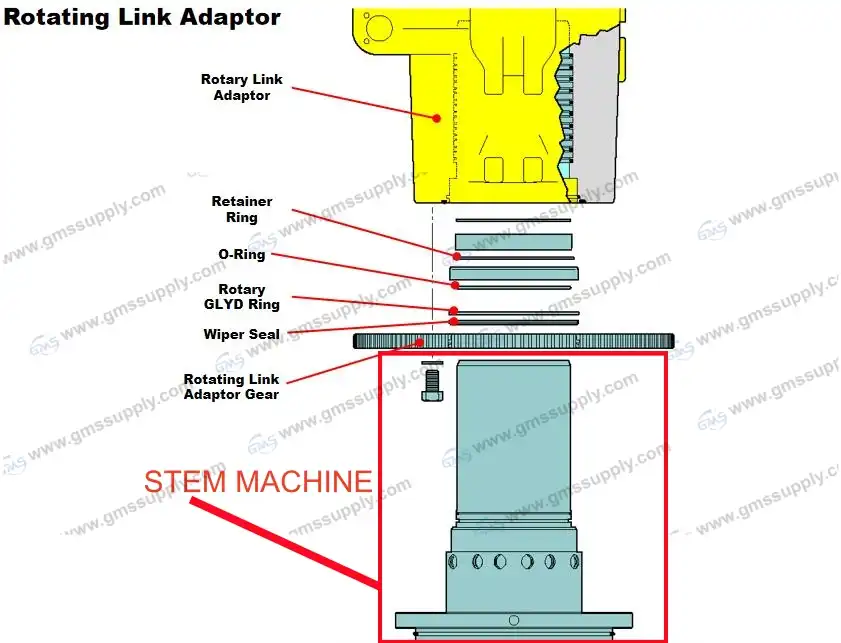
If you run or maintain a top drive system in oil and gas drilling, maintaining the 30177594-500 stem machine in excellent operating condition is non-negotiable. This part is utilized in the TDS-11 and TDS-9SA top drive models' rotating link adapter assembly (P/N 121341, 30173277). It transfers torque and provides structural support to the adapter assembly. A well-maintained stem keeps everything operating on time and avoids expensive unscheduled stoppages. This tutorial covers all you need to know to properly manage this element, from daily inspections to purchase planning.
Understanding the 30177594-500 Stem Machine: Core Specifications and Maintenance Needs
The 30177594-500 stem machine is a precision-made component produced from heat-treated high-alloy steel. Induction-hardened contact surfaces resist scoring and abrasive wear. The core material absorbs impact energy during drilling cycles with high loads. Dimensional precision is preserved to ISO IT6 tolerance grades, with concentricity and straightness within 0.01mm to avoid vibration in high-speed applications.
The OEM part numbers are 30177594-500 and 117833-500. This part fits the Rotating Link Adapter Assy 121341 and 30173277 used on TDS-11 and TDS-9SA top drive versions.
Typical maintenance problems with this stem are:
- Surface wear in contact zones: The hardened surface layer may be degraded during long-term cyclic stress. When the protective shell wears through, the material below is far more prone to quick breakdown.
- Seal performance: The stem’s precision-ground finish (Ra < 0.4 micron) is key for seal performance. Hydraulic fluid leaks and irregular actuator behavior result from surface scoring or corrosion.
- Dimensional drift from thermal cycling: In active drilling situations, thermal cycling may cause dimensional drift over time if inspections are spaced too far apart.
Maintenance teams are warned early of possible failures by monitoring symptoms such as abnormal vibration, fluid leakage around the adapter assembly or auditory banging during operation. Picking up on these early symptoms can save you a lot in repairs.
Best Practices for Maintaining the 30177594-500 Stem Machine
The cheapest approach to get this stem to last longer is to do periodic maintenance. Here's a handy beat for field teams to utilize during inspections:
Daily check for seepage of hydraulic fluid surrounding the seal assembly, listen for weird noises while the machine is operating, and make sure that the adapter assembly has no horizontal play or peculiar resistance.
You should inspect the stem's contact regions weekly for scoring or pitting of the surface, ensure they are properly lubricated, and confirm that all screws in the spinning link adapter assembly are torqued to the proper amount.
In addition to this, every month, a more comprehensive measurement should be made using calibrated instruments to ensure the Stem for rotating link adapter assy 121341 (30173277) remains within the permitted range. A thorough cleaning of the work area should be carried out to get rid of drilling fluid residue, and an evaluation of the quality of the surface coating.
Lubrication requires careful attention. During installation or reassembly following inspection, an assembly paste based on molybdenum disulfide (MoS2) should be used on the working surfaces of the stem. This prevents dry-running friction during the initial phase of pressure build-up, a prime source of early surface degradation.
The 2 most prevalent indicators of a problem that has to be corrected are stick-slip movement in the actuator and hydraulic fluid seeping around the seal region. If any of these occurs, remove the stem and inspect the surface before proceeding. If the part has scoring that displays the base material, it has to be replaced. Re-machining is not a repair option since it takes away the hard layer and affects the geometry of the seal.
How Predictive Maintenance Reduces Top Drive Downtime and Costs
In the field, when time is limited, reactive repair – waiting for something to break – is sometimes the only game in town. The problem is that if a stem, which transmits torque in a top drive system, suddenly breaks, it may halt the whole drilling string. Lead times for replacements, shuffling personnel around, and the potential for further damage to the adapter system all add up rapidly.
That’s where predictive maintenance comes in. Adding vibration sensors and sound monitoring gear to the top drive assembly also allows maintenance personnel to monitor how the stem and adapter assembly behaves over time. And if readings deviate from the baseline specified, a replacement may be scheduled for the next maintenance window, instead of during an emergency halt.
A case study in upstream oil and gas operations showed that changing the inspection of top drive components from reactive to condition-based reduced unscheduled downtime by roughly 30% and the cost of acquiring replacement parts by a considerable amount. The funds invested in data collection were paid back in two drilling cycles.
The ROI (return on investment) for such a change is straightforward to calculate for purchasing managers: just compare the cost of one unplanned shutdown versus the cost of monitoring hardware and stocking a spare parts inventory. In the majority of the drilling operations underway, the numbers work for planned maintenance.
Ensuring Safety and Compliance During Maintenance
Before disassembly can commence, top drive parts like this stem must be handled according to the letter of lockout-tagout (LOTO) protocols. The top drive must be shut off and locked out so it cannot be switched on by mistake. Workers making precision parts should wear appropriate PPE, including steel-toe shoes, eye protection, and cut-resistant gloves.
To prevent the stem from rusting, it should be kept in a temperature-controlled environment and covered in VCI (Volatile Corrosion Inhibitor) packaging. If the component has been kept for over 2 years, it should be checked on the exterior before assembly, even if it seems to be sound on the outside.
The operator is in charge of ensuring that all safety requirements for drilling are observed. This includes criteria specified in API specifications for top drive systems. Keeping records of inspection dates, replacement records, and torque verification logs is important for internal audits and regulatory assessment. Also, working with suppliers who provide parts with ISO 9001 certification helps to strengthen the chain of custody, which is critical for safety audits.
Optimizing Maintenance Decisions for Procurement Managers
If you are responsible for procuring top drive replacement parts, it is better to have the 30177594-500 stem in stock rather than ordering it every time you need it. A single lost Stem for rotating link adapter assy 121341 (30173277) may interrupt the whole drilling operation since it carries the strain and supports the connection.
When you're purchasing anything, the most crucial things to consider are:
- Dimensional verification: Request CMM (Coordinate Measuring Machine) inspection reports to verify run-out and diameter tolerances and cylindricity before accepting a shipment.
- Stock availability and lead time: If there are drilling projects in progress, availability of stock is a more important consideration in procurement than unit pricing. A stem accessible from inventory avoids the lead time risk associated with made-to-order parts.
- Bulk buying: For operators with several TDS-11 or TDS-9SA machines, bulk buying of stems against a maintenance plan minimizes the cost per unit and ensures supply continuity.
Total cost of ownership analysis always shows that obtaining certified, dimensionally confirmed replacement stems is less costly over time than repairing issues caused by parts that do not fit. This is true even if the difference in prices is minimal.
Conclusion
It's easy to keep the 30177594-500 stem machine in good shape if you stick to an organized check schedule, use the right lubricant when putting it together, and replace the part before it wears down to the seal zone. The best way for buying teams to protect drilling downtime is to always have verified, ISO-certified stock on hand. When you choose a supplier with a large inventory, quality paperwork that can be tracked, and quick technology help, you get rid of the uncertainty that comes with reactive buying.
FAQ
1. What are the signs that this stem needs replacement?
Hydraulic fluid leakage around the seal area, stick-slip actuator movement, and audible knocking during operation all indicate potential stem wear. If surface scoring exposes base material, replacement is required.
2. Can this stem be repaired if the surface is scored?
No. The hardened surface layer and pre-precision-ground finish cannot be restored by re-machining without altering dimensions and removing the hardened case. Standard protocol is replacement.
3. How should this stem be stored before use?
Store in VCI packaging inside a climate-controlled space. Inspect the surface visually if the part has been in storage for more than two years before installing it.
4. Which top drive models use this stem?
This stem is compatible with TDS-11 and TDS-9SA top drive models, applied in Rotating Link Adapter Assy 121341 and 30173277.
Source Your 30177594-500 Stem Machine Supplier Through GMS
For more than ten years, GMS has provided oil and gas drilling companies with approved top drive spare parts. You can buy the 30177594-500 stem machine right now. It comes with ISO 9001 certification and quick technical service. Our team can quickly get you a replacement unit for a single TDS-series rig or a fixed supply plan for a number of them. You can check availability and get a quote right away by emailing sales@gmssupply.com.
References
1. American Petroleum Institute. API Specification 8C: Drilling and Production Hoisting Equipment. API, 2012.
2. ASTM International. ASTM E1444: Standard Practice for Magnetic Particle Testing. ASTM International, 2016.
3. International Organization for Standardization. ISO 9001:2015 Quality Management Systems — Requirements. ISO, 2015.
4. Society of Petroleum Engineers. SPE Drilling & Completion Journal: Top Drive System Performance and Reliability. SPE, 2019.
5. American Society of Mechanical Engineers. ASME B46.1: Surface Texture — Surface Roughness, Waviness, and Lay. ASME, 2019.
6. National Institute for Occupational Safety and Health. NIOSH Publication No. 2011-157: Preventing Worker Deaths and Injuries When Servicing Equipment — Control of Hazardous Energy (Lockout/Tagout). NIOSH, 2011.
_1754380102909.webp)
Learn about our latest products and discounts through SMS or email