- English
- French
- German
- Portuguese
- Spanish
- Russian
- Japanese
- Korean
- Arabic
- Greek
- German
- Turkish
- Italian
- Danish
- Romanian
- Indonesian
- Czech
- Afrikaans
- Swedish
- Polish
- Basque
- Catalan
- Esperanto
- Hindi
- Lao
- Albanian
- Amharic
- Armenian
- Azerbaijani
- Belarusian
- Bengali
- Bosnian
- Bulgarian
- Cebuano
- Chichewa
- Corsican
- Croatian
- Dutch
- Estonian
- Filipino
- Finnish
- Frisian
- Galician
- Georgian
- Gujarati
- Haitian
- Hausa
- Hawaiian
- Hebrew
- Hmong
- Hungarian
- Icelandic
- Igbo
- Javanese
- Kannada
- Kazakh
- Khmer
- Kurdish
- Kyrgyz
- Latin
- Latvian
- Lithuanian
- Luxembou..
- Macedonian
- Malagasy
- Malay
- Malayalam
- Maltese
- Maori
- Marathi
- Mongolian
- Burmese
- Nepali
- Norwegian
- Pashto
- Persian
- Punjabi
- Serbian
- Sesotho
- Sinhala
- Slovak
- Slovenian
- Somali
- Samoan
- Scots Gaelic
- Shona
- Sindhi
- Sundanese
- Swahili
- Tajik
- Tamil
- Telugu
- Thai
- Ukrainian
- Urdu
- Uzbek
- Vietnamese
- Welsh
- Xhosa
- Yiddish
- Yoruba
- Zulu
When Is 30125052 Jaw Assembly Past Its Grip Tolerance?
It's past its grip tolerance if the 30125052 Jaw Assembly can't hold drilling tools with steady, even contact or if its measured sizes are different from what's written in the manual for your tool. This is clear from the fact that it slips, has rounded edges for better grip, has uneven wear marks, cracks, and clamps that don't work. You shouldn't use the same wear number for all rigs. Instead, you should measure the part and compare it to approved drawings or the service manual. Let your team make an informed choice by reading this guide. It explains why to inspect, how to do it, when to replace something, and how to check the supplier.
What Does "Grip Tolerance" Mean on a 30125052 Jaw Assembly?
What is the limit of grip? It's the range of sizes and strengths that a jaw can securely hold. It talks about the bearing's alignment, its operating clearance, its gripping power, and the amount of wear that's okay. Even if a worn jaw clamps unevenly, makes noise, or can't be used again and again, it might still look like it can be used. I never give a general wear number because it depends on the load, the type of top drive, and how the jaws are made. When it comes to size tolerances, ISO 286-1 is the reference code. Your equipment drawings will show you the limits that your part must follow.
What Causes a 30125052 Jaw Assembly to Exceed Its Grip Tolerance?
A jaw is too weak to work because of several things. First, the contacts wear down over time and are clamped many times. A shock load, too much clamp force, and tools that aren't the right size may cause more damage. One side of the jaw can wear down because of the wrong way of mounting, loose fasteners, or not being in the right place. Because of drilling fluid, water, metal particles, and corrosion, the surface that you grip gets rougher over time. This can happen faster if you don't do maintenance. Watch out for rounded edges, grooves, pits, deformation, and uneven contact. If you don't fix any alignment problems or worn support parts first, it will cost more to buy a new jaw. Also, the new jaw might break too soon.
How to Inspect a 30125052 Jaw Assembly for Grip-Tolerance Loss
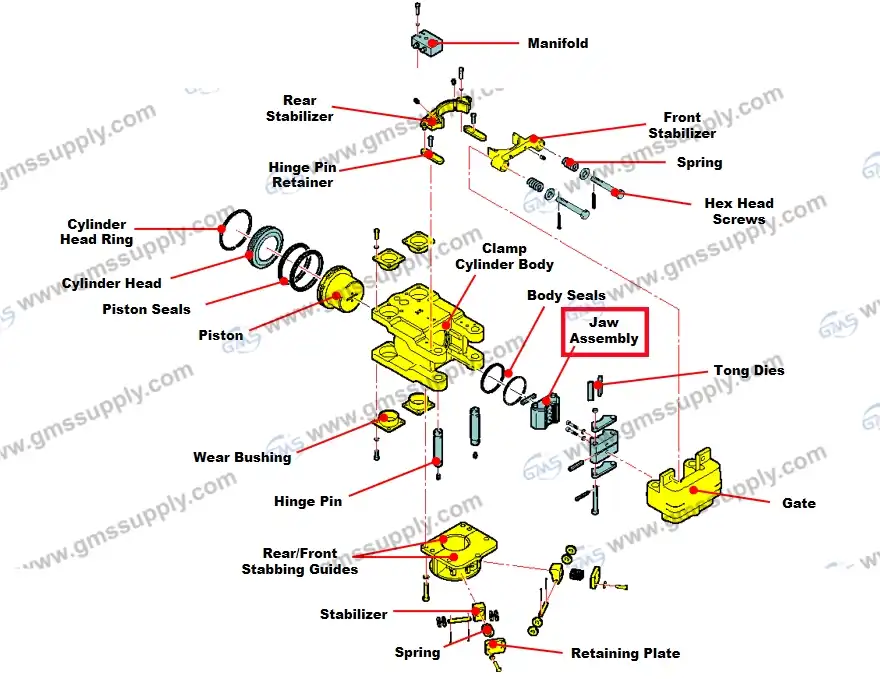
Checks for damage, measurements, a look at the alignment, and a controlled functional test of the NOV TDS-11SA Jaw Assy 30125052 should all be done at the same time. Look for cracks, chips, deformation, corrosion, loose parts that move around, strange noises, and cycles that take longer to complete. Check the tools to make sure they are accurate before you use them to measure the thickness of the contact face, the range of openings, the distance between mounting holes, the installed height, and the contact angle. Then, compare the readings to approved plans, the parts list, or a part that hasn't been used yet. People can use marking compound, feeler gauges, and dial indicators to make sure they have the right contact pattern, as long as the method is safe for the tools. In API RP 8B, the steps for inspecting and maintaining hoisting equipment are laid out. This helps your group figure out when to do these checks.
When Should a 30125052 Jaw Assembly Be Repaired, Adjusted, or Replaced?
Small problems can usually be fixed by cleaning, using the right oil, retorquing the screws, or adjusting the alignment, as long as the jaw stays strong and doesn't go too far. You should get a new one right away if it has cracks, permanent deformation, severe corrosion, too much dimensional loss, slippage, or doesn't work the way it should. I don't use a calendar to decide when to replace something. Instead, I look at its condition, operating cycles, load, abrasiveness, environment, and wear history to decide when to replace it. Watch out for the guides, frames, pins, bushings, and holders all at the same time. Someone who is worn out can quickly hurt a new jaw.
Choosing the Right 30125052 Jaw Assembly for Your Top Drive
The part number alone doesn't mean it fits. The NOV Varco TDS-11 and TDS-9SA top drives use the 30125052 Jaw Assembly for the PH75 30157287-9 Clamp Cylinder Assembly. While the drives are working, this part keeps the drilling tools in place. The following numbers can be used to find this item: 30125051, 125053, 30173233, 80492, and 122109. That part can be found in our NOV Varco Top Drive Parts area. From an ISO 9001 facility, the part ships in two to four weeks if it's in stock. It's made in China.
Before you place your order, make sure you know the model of your top drive, where the assembly goes, how to mount it, the material, and the most important measurements. These checks make sure you don't order a part that looks good but doesn't fit.
You can use the manufacturer's numbers, names, and descriptions as a guide. The company that makes the instruments does not let GMS sell their goods.
How to Select a Dependable 30125052 Jaw Assembly Supplier
A good supplier can help you buy things and check them for problems. Check the part number, such as NOV TDS-11SA Jaw Assy 30125052, get dimension drawings, information on the material and how it was treated on the outside, records of inspections, information on the warranty terms, and details on how the item is packed. Find out if the item is in stock, how long the lead time is, and what checks the supplier does on the goods before they ship them. Take a look at the unit price, the freight cost, the minimum order quantity, the expected service life, and the cost of downtime.
GMS has helped people in the building industry, the food processing industry, the oil and gas industry, and the woodworking machinery industry since 2006. We are in charge of everything, from the raw materials to the packed goods. We keep a lot of stock on hand, so we can respond quickly. We also offer service after the sale and solutions that are easy to change.
30125052 Jaw Assembly Installation and Maintenance Guide
First, look at the part number, then take the equipment apart, release any stored energy, and clean the mounting area. Finally, compare the new jaw to the old one. Write down where it was before, check the holders and hardware, and then put the new one in the right way. Make sure the fasteners are tight enough according to the instructions that came with the equipment. I'm not going to list torque values here since they vary from model to model. The last steps are to make sure everything is lined up right and do a controlled functional test. Plan to clean, check the fasteners, do visual checks, and go over everything again after an overload as part of regular maintenance. Check it more often if it will be used in harsh, abrasive, or corrosive conditions.
A Practical Decision Process: Is the 30125052 Jaw Assembly Past Its Limit?
It is clear that jaw wear is not the same as wider equipment trouble. First, write down the issue, the weight, the size of the tool, and how it will be used. Next, look at the jaw, its holder, its driver, its guides, its pins, and its bushings. When you compare your measurements and grip performance to the official specs, don't go by your first thoughts. Then mark it as "serviceable," keep an eye on it, fix it, make changes to it, or get a new one. Finally, write down the size, the type of part used, the manufacturer, the batch number, and the date it was installed. These records help you plan repairs, guess how much stock you'll need, and decide what to buy next.
Conclusion
A 30125052 Jaw Assembly is no longer within its grip tolerance if its measured dimensions or ability to grip don't meet the standards. This is true even if it's just old. We lose most of our stuff because of wear and tear, shock loads, misalignment, dirt, and poor maintenance. It's easy to spot because of cracks, slippage, and uneven contact. Some good ways to figure out if the part can be fixed, monitored, or replaced are to look at it, take measurements that are accurate, and run a controlled functional test. That's why you need to check the parts around the new jaw as well. Worn-out holders, pins, and bushings can hurt it. Making sure it fits the TDS-11 or TDS-9SA and getting proof from the supplier helps you make safer choices and cuts down on stops that you didn't plan.
FAQ
1. How do I know if the jaw isn't right?
Compare the measured sizes and how well the jaw fits with the service manual or good drawings. It's not safe if the edges are rounded or if the contact isn't even.
2. Is there a certain amount of wear?
That's not possible. The limit depends on the type of top drive, the load, and the use, so look at the instructions that came with your gear. The Clamp Cylinder Assy PH75 30157287-9 is used in TDS-11 and TDS-9SA top drives, and this part fits them. Make sure you know what you want before you place your order.
3. How often should I check it?
The load, duty cycle, and environment will determine how long it should be between checks. When you're done with a lot of work, check it more often.
4. What do I need to send to get a quote?
The part number, the model of the equipment, the amount, the use, the destination, the schedule, and photos or measurements.
Request a 30125052 Jaw Assembly Quote from GMS
To get the equipment you need, email sales@gmssupply.com with the model, quantity, use, delivery location, and any photos or measurements you have. GMS is a supplier of the 30125052 Jaw Assembly that is ISO 9001 certified and has a lot of stock. There are stock lead times and four-week lead times. GMS can check compatibility before you order to make sure it will work. Go to gmssupply.com to learn more about our top drive spare parts.
References
1. API Specification 8C, 2012
2. API Recommended Practice 8B, 2014
3. ISO 9001 Quality Management Systems – Requirements, 2015
4. ISO 286-1 Geometrical Product Specifications (GPS) – ISO Code System for Tolerances on Linear Sizes, 2010
5. ASM Handbook, Volume 18: Friction, Lubrication, and Wear Technology, 1992
6. Machinery's Handbook, 31st Edition, 2020
Learn about our latest products and discounts through SMS or email